CBAM from 2026: what manufacturers importing steel and aluminium must do
The definitive carbon border regime started on 1 January 2026. The threshold is 50 tonnes a year, the first declaration and certificates are due 30 September 2027.
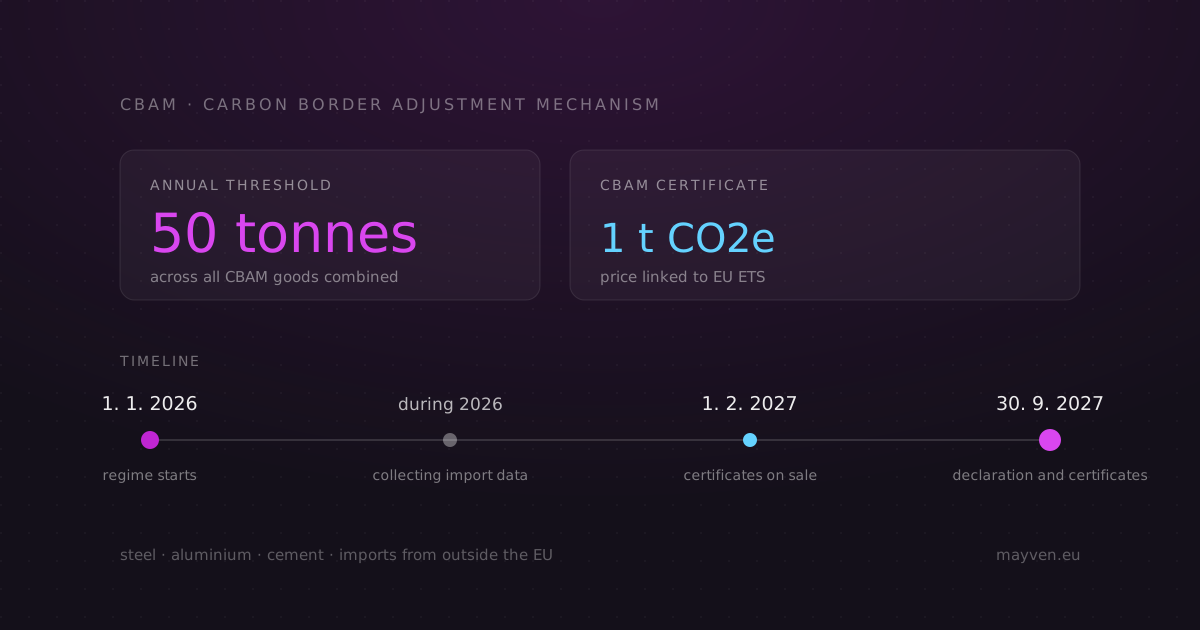
If your company imports steel, aluminium or cement into the European Union from outside it, the definitive CBAM regime, the carbon border adjustment mechanism, has applied since 1 January 2026. The decisive line is 50 tonnes per calendar year across all CBAM goods combined. Above it you need the status of an authorised CBAM declarant, and your first declaration for 2026 is due by 30 September 2027, together with the certificates that cover it. This follows from Regulation (EU) 2023/956 as amended by Regulation (EU) 2025/2083.
| Date | What happens |
|---|---|
| 1 Jan 2026 | Definitive regime starts. You track the annual total of imported CBAM goods |
| during 2026 | You collect import data and embedded emissions data from non-EU producers |
| 1 Feb 2027 | Sale of CBAM certificates opens on the common central platform |
| 30 Sep 2027 | First annual declaration for 2026 and surrender of certificates |
| annually by 30 Sep | Declaration for the previous calendar year and surrender of certificates |
Who does CBAM actually apply to?
The obligation falls on the importer who releases the goods into free circulation in the Union. Buying inside the Union is not covered: if you buy steel from a trader who has already imported and cleared it, the obligation was theirs.
The scope is not described in words but by customs codes in Annex I to the regulation. The first practical step is to compare the eight digit CN codes on your imports against that annex. For steel and aluminium the commercial description of the material is irrelevant; the code under which the goods are cleared is what counts.
The 50 tonne threshold is an annual total across all CBAM goods, not a limit per shipment, per line item or per material. For hydrogen and electricity it does not apply at all.
Stay below 50 tonnes for the year and you are exempt from authorisation, from the annual declaration and from certificates.
Who must become an authorised declarant?
Above the threshold, CBAM goods may only be imported by an authorised CBAM declarant. An indirect customs representative may take on that role, but only if they expressly agree. The application is filed electronically through the CBAM registry and, besides identification details and the EORI number, it demonstrates financial and operational capacity to meet the obligations (Article 5).
Do not wait until you actually cross the threshold. Customs authorities may refuse release without the required status, so a company that reasonably expects to exceed 50 tonnes should apply in advance. The European Commission warns explicitly that late authorisation risks delays in customs clearance.
What is reported and what does a certificate cost?
One CBAM certificate corresponds to one tonne of CO2e embedded in the imported goods, and its price is linked to the price of EU ETS allowances. The declaration states quantities by type of goods, the calculated embedded emissions, the number of certificates being surrendered and a report from an accredited verifier. If a carbon price was demonstrably paid in the country of origin for the same emissions, the number of certificates can be reduced accordingly.
The hard part is not buying certificates. It is the data. Details about the installation, the production route, energy consumption and direct emissions have to come from the non-EU producer, and they must survive verification. That belongs in supplier contracts now, not in August 2027.
What are the penalties?
| Breach | Consequence |
|---|---|
| Importing above the threshold without authorised declarant status | Financial penalty, assessed with regard to the emissions embedded in all relevant goods imported that year. Customs may refuse release |
| Failing to surrender enough certificates by 30 September | A penalty for each missing certificate, linked to the EU ETS excess emissions penalty. Paying it does not remove the duty to surrender the certificates |
| No declaration, or the wrong number of certificates | The authority calculates the obligation from available data and gives one month to make up the difference |
For a mild and unintentional overshoot, particularly up to 10 percent, the authority may take the circumstances into account and impose a lower penalty. It is not a tolerance band to rely on.
Where an AI agent helps
The administrative core of CBAM is collecting and matching documents: invoices, customs declarations, CN codes, net weights and emissions data sheets from suppliers in various formats and languages. That is exactly what we deploy agents for: they read the documents, extract the values, maintain a running tally of weight per code and flag when the annual total approaches the threshold. For companies that will not send supplier data to a public cloud, it runs on premise.
Frequently asked questions
I import 30 tonnes of steel and 30 tonnes of aluminium. Am I under the threshold? No. The 50 tonne threshold is the total across all CBAM goods in a calendar year, so your case is 60 tonnes and the obligations apply.
Our customs agent handles imports. Does the obligation move to them? Only for an indirect customs representative, and only if they expressly agree to act as the authorised declarant.
I will cross the threshold only in December. Can I apply then? You risk your shipments being stopped, because the status should be in place before the goods arrive. If crossing the threshold is likely, apply in advance.
I buy steel from a German trader rather than directly from outside the EU. Does CBAM apply to me? Generally not, if the trader already released the goods into free circulation. The obligation attaches to importing into the Union, not to a later purchase within the single market.
Sources
- Regulation (EU) 2023/956 establishing the carbon border adjustment mechanism
- Regulation (EU) 2025/2083, CBAM simplification, the 50 tonne threshold, deadlines and penalties
- European Commission: CBAM, official guidance and questions and answers
We verified the legal facts in this article with Nexana, a research tool for EU and national legislation.